
Your Aging Clients’ Darkest Secrets: Addiction and Substance Abuse

Your Aging Clients’ Darkest Secrets: Addiction and Substance Abuse

Do any of your older clients have a problem with alcohol or addiction? You may be surprised at the prevalence of these problems in our older population.

Opioid addiction is not just about young people. Some sources tell us that opioid dependency is present among people of all ages, which can include your aging investor clients. According to a treatment facility exclusively for adults over age 50, the number of adults over 50 with substance abuse problems will double from 2.5 million in 1999 to 5million in 2020.

Why should this matter to you, as an advisor? There are several reasons why this client health issue is important, particularly in retirement planning. First, any substance abuse problem can affect financial decision-making capacity. Dependency can lead to desperation, related physical issues added to existing age-related issues and loss of capacity to make reasonable and necessary judgments about any investment. Further, it can destroy family relationships, just when you may need family members to get involved in helping an older client make essential decisions about the portfolio and needed adjustments.

Your aging client may not tell you about being substance dependent but sometimes you can see the signs. They may confess to "a bit of drinking too much", or feeling depressed about their future. Perhaps the client comes to your office reeking of alcohol. Or you see them taking pills right in front of you, with a shaking hand. That behavior doesn't look to you like just some benign blood pressure pill or the like. There's a frantic air to it, needing that pill fix. You can't be sure but your gut tells you something isn't right. Listen to your gut.

Elders with a drinking problem are not often talked about but we certainly hear about the issues they cause at AgingParents.com, where we work with families to solve problems with the elders and their adult children. According to publications at the National Institutes of Health, prevalence rates for older-adult at-risk drinking (defined as more than 3 drinks on one occasion or more than 7 drinks per week) are estimated to be 16.0% for men and 10.9% for women. There is also a substantial proportion of the older-adult population who are binge drinkers (generally, 5 or more drinks per episode). This is not some small problem among us.

You're not a doctor, nor a mental health professional. Why should you care? Should you do anything about a client who appears to you to show signs of substance abuse risk? It can affect your client relationship if you do nothing. Your client can accelerate age-related physical decline faster with substance problems than if they aren't part of the picture. If they decline too much, you can't work with them. If the client can't communicate or can't make decisions, you may have to get rid of the client and the fees you earn on managing that portfolio. The client can ruin your connection to them.

Have a plan

You can think ahead and develop a plan if you suspect these issues are affecting your client.

One essential strategy involves being prepared to reach out to your client's family or close friends for help. Many, though not all investors have done some estate planning. Often they wanted to protect their legacy and had a trust and will drawn up by an attorney. Imagine that all their financial assets you manage are in a trust. The trust will name a successor to your client, who is the person who decided what the trust should contain. The successor trustee can assume authority while your client is living, when he or she becomes impaired. Trusts are written in many ways with no standard applied to when an impaired trustee, your client, must or can step down and let the successor take over.

What to do first

You can speak with your client about whether they have done estate planning. This should be part of your job anyway. You don't want them to fail to do this and have too much of their assets unnecessarily given to taxes after they pass or have them go where the client didn't want them to go. Educate them. That's what you do as part of your services. While you are on the question, find out whom they've appointed as a successor trustee (assuming there is indeed a family trust). Then ask for permission, in writing to communicate with that successor trustee, whom they chose, "in case of emergency" or some other event that may cause them to be unable to function, such as a stroke. For help in getting the permission right, reach out to us at AgingInvestor.com. We can help!

How to use permission to communicate with a third party

That permission will give you one essential thing: the ability to tell the appointed person that you are worried about what you have observed (be specific; e.g., strong odor of alcohol, forgetting appointments, etc.). You can simply request their help. It's up to them to take it from there. You may not be able to solve any problem your client has but with this kind of communication, you are doing all you have a right or obligation to do to be of service. And who knows, your contact with the right and motivated appointee, often a family member, could be the trigger that starts their stepping in to assist with financial decisions.

Try this and you'll sleep better at night rather than worrying that your impaired client may do something dumb with their money, and expose you to scrutiny by heirs for your failure to act. This simple and proactive step can apply not only to a client you think may have a problem, but to any aging client. Make it your practice. It can prevent your loss of management of the client's assets.

Where Will Your Client Live In Older Age?

Where Will Your Client Live In Older Age?

Most advisors who even ask this question of their retirement-aged clients never spend time on it. About 90% of those asked say they want to remain in their own homes as long as possible.  That sounds fine. Until one faces physical decline, cognitive impairment or both. The advisor providing competent guidance about financing aging at home had better know the facts.

None of us like to think about losing physical ability or needing help. We abhor the thought of losing our total independence. In our view at AgingInvestor.com, the only advice clients are getting is about the long term picture is whether or not to purchase long term care insurance. Since most people don't do that, the actual costs of living at home can boggle the mind. It's the best advisor's obligation to educate your client about the risks of the plan to age in place, just as it is your obligation to educate them about balancing their portfolios. You are giving the client added value if you take the time to talk them through the risks and dollars they may need to have available.

Here are some briefly stated facts from a real case in which an 89 year old wanted to age in place and his wife promised he would never have to leave home.

At the outset of his declining health, he had about $3M in invested assets. His portfolio was healthy and balanced for his age, according to conventional wisdom. He began to lose his ability to walk due to multiple medical problems. His wife hired home helpers, three days a week at first. As his conditions progressed he needed more and more help.  He had to have a wheelchair, and a special van. A stair chair was installed in their two-story home. By the time he reached age 95, he was spending over $150,000 a year on care and assistance around the clock. In the space of time during which he was steadily losing independence until he passed away at 95, his assets were depleted to the tune of $2M. He lived in a higher end market for the needed help but the reality is that in any market, the kind of care he needed would be very expensive.

For him, aging in place was more costly than a skilled nursing facility would have been. Home modifications, private caregivers, (none of whom were licensed nurses), equipment, medications, adaptive devices, etc. drained his resources by 2/3. And not everyone has as much invested as he had to even start the journey. His wife had her own assets and she paid the cost of household maintenance, taxes, food, and utilities with her funds. Had she relied on him for those things too, there would likely have been little left at the end of his life.

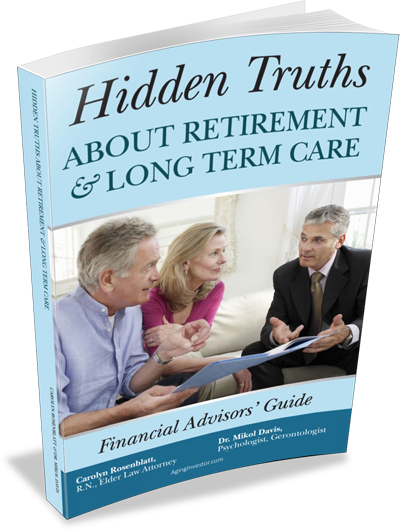
It is not all doom and gloom however. Many clients live rather well in their last years without all the care this gentleman needed.  Some get by with family caregiving help, and some have fewer medical conditions. But if you are going to competently help your clients plan for longevity, it's essential to understand the real out of pocket costs of aging in place or anywhere else outside the home. If you want to add value to your services to older clients, know what they need to know to properly anticipate what can happen with living into one's 90s and beyond. Learn all the actual costs of care for every aging client option in our book, Hidden Truths About Retirement & Long Term Care. Be well prepared to walk your client through the scenarios they could face in their futures.  You distinguish yourself from other advisors when you sharpen your knowledge in planning for longevity.

By Carolyn Rosenblatt, RN, Attorney, AgingInvestor.com

Three Things Every Advisor Must Do With Cognitively Impaired Clients

Three Things Every Advisor Must Do With Cognitively Impaired Clients

Everyone is going to have someone in your book, sooner or later, who has cognitive decline. Studies tell us that the average advisor has at least 7 clients with some form of cognitive impairment now. We’d bet that when you became an advisor, your education did not give you guidance about what to do when you see the warning signs of decline in a client’s mental function. With increasing longevity, we have a problem like never before.

What are you supposed to do about it? Isn’t this the family’s problem? In truth, it’s not just the family’s issue—it’s an issue for everyone in an elder’s life, including the financial advisor. There are three essentials everyone should be doing to keep yourself and your client safer.

  1. For openers, you, the advisor must be familiar with the warning signs of cognitive impairment. At AgingInvestor.com, we offer a free downloadable checklist of these red flags, so you can keep it and use it as a guide. Please do. You can’t ignore these signs, as they are very likely to worsen over time. When your client is too “out of it” to make decisions, you are in trouble.
  2. Have two or three trusted contacts in your client’s file. If you have never asked for even one, now is the time. Make it part of your office policy, your task at a portfolio review, or what you decide to do this week because you are a smart, plan-ahead person. Why two or three? Because family members are often named first and family, unfortunately, are the ones who steal from aging folks most often. One of the contacts should be outside the family.
  3. Get written permission from your client to speak to their estate planning attorney, their accountant and any other professional involved in managing their affairs. This can be extremely helpful to you as a client begins to show those red flags. All of the professionals can act together to protect the client, get an appointed surrogate decision maker in place or otherwise reduce the risks of financial fraud and abuse. All it takes to give permission is a letter from your client, a simple but very important step you must take. Draft it for the client, ask him or her to sign and do it. 
                                                                                                                     
    The point of this action is to protect a vulnerable client from getting ripped off, from failing to attend to financial business, and from the neglect of basics that often accompanies this kind of mental impairment. You don’t need to be a hero. You do need to be a professional in the way you treat these older clients. And remember that if the client is “losing his marbles” and money gets drained by predators, decimating the portfolio, the family may look to you if you failed altogether to act. Remember, their inheritance could be at stake.

For more on working with your aging clients, check out our book, Succeed With Senior Clients: A Financial Advisor’s Guide to Best Practices.


Dr. Mikol Davis and Carolyn Rosenblatt, co-founders of AgingInvestor.com

Carolyn Rosenblatt, RN, Elder Law Attorney offers a wealth of experience with aging to help you create tools so you can skillfully manage your aging clients. You will understand your rights and theirs so you can stay safe and keep them safe too.

Dr. Mikol Davis, Psychologist, Gerontologist offers in depth of knowledge about diminished financial capacity in older adults to help you strategize best practices so you can protect your vulnerable aging clients.

They are the authors of "Succeed With Senior Clients: A Financial Advisors Guide To Best Practice," and "Hidden Truths About Retirement And Long Term Care," available at AgingInvestor.com offers accredited cutting edge on-line continuing education courses for financial professionals wanting to expand their expertise in best practices for their aging clients. To learn more about our courses click HERE

The DOL Fiduciary Standard & The Future: Your Client’s Heirs Are Watching You

The DOL Fiduciary Standard & The Future: Your Client’s Heirs Are Watching You

With the recent Texas Court of Appeals decision striking down the authority of the DOL to enforce its fiduciary standard, the industry remains enmeshed in its own conflict. Some firms embraced the concept of acting in a client's best interests for retirement accounts. Others fought it tooth and nail. What about your own clients if you are a broker and do not have to follow the DOL rule? Do you think no one is going to question you, your advice, or your commissions and fees?

With the amount of publicity generated in the long fight to get the rule passed in the first place, and the aftermath efforts to have it overturned, the public is more aware than ever of the need for transparency in what you recommend and in what advice you offer. Some clients may trust you and never ask a question about why you suggest a product, but don't count on that being universal. The public's perception of what you do is changing and in a sense, the cat is out of the bag.

In their marketing, firms that embraced the fiduciary standard can brag about it and when you have rejected the premise of prioritizing a client's best interest, you can't brag about it. In fact, prospects may be asking more and more often whether you are a fiduciary. What are you going to tell them?

Here at AgingInvestor.com, we educate advisors of all stripes about managing aging clients, particularly those with diminished capacity. Our associated site, AgingParents.com, is a resource for those with aging loved ones. At AgingParents.com, we advise and counsel families about watching over their aging parents' finances and we strongly encourage them to review what their elders are doing with their money. When they follow our advice, they are going to be looking at what you've done with the elder's portfolio. If you adhere to a fiduciary standard, no problem is likely. If you don't, beware. Your client's heirs are gradually assuming power over their parents' investments as their loved ones age and become less capable of financial decision making. Dementia is a frequent cause of loss of capacity. Often the adult children can take over as successor trustees or agents who are appointed as power of attorney long before the parent passes.

About 70% of women change advisors after the death of their spouses. Their adult kids will be encouraging them to find someone with a fiduciary standard. Perhaps large numbers of adult children will switch advisors before the death of the patriarch, once they scrutinize what choices you have recommended. They may even get a second opinion about your work.

This is merely a caution to any advisor who does not adopt a fiduciary standard, regardless of whether it is mandated legally. The next generation is looking at a parent's portfolio with fresh eyes and you may lose clients because of this. Keep the older clients in your book  for life and future generations by staying the course as an advocate and making decisions in their best interest, always.

<a href="https://agingparents.lpages.co/leadbox/14351a433f72a2%3A160053496b46dc/5696133603000320/" target="_blank" style="background: rgb(50, 100, 163); color: rgb(255, 255, 255); text-decoration: none; font-family: Helvetica, Arial, sans-serif; font-weight: bold; font-size: 16px; line-height: 20px; padding: 10px; display: inline-block; max-width: 300px; border-radius: 20px; text-shadow: rgba(0, 0, 0, 0.25) 0px -1px 1px; box-shadow: rgba(255, 255, 255, 0.5) 0px 5px 3px inset, rgba(0, 0, 0, 0.5) 0px 5px 3px;">10 Hidden Truths of Retirement and Long Term Care - Checklist</a><script data-leadbox="14351a433f72a2:160053496b46dc" data-url="https://agingparents.lpages.co/leadbox/14351a433f72a2%3A160053496b46dc/5696133603000320/" data-config="%7B%7D" type="text/javascript" src="https://agingparents.lpages.co/leadbox-1522784019.js"></script>

How Can You Differentiate Your Business Model From The Competition?

How Can You Differentiate Your Business Model From The Competition?

If you see how firms market themselves these days, you often see them pitching how much they care about their clients, and how much client relationships matter to them. Really? How about your senior clients? And how do you demonstrate that you care about them, now that they're retired and drawing out money, not contributing earnings?

Our aging population is growing and you are more likely than ever to see aging clients in your book of business. One way to differentiate yourself from those firms around you is to focus specifically on the senior market. When seniors can depend on you through the journey of aging, you will likely have loyalty for life from them.

But what does that mean, being able to depend on you? Of course, you are going to do what every financial professional is supposed to do and competently manage their portfolios. That alone does not set you apart. What will make you a standout is to focus on the unique needs seniors have and help your clients prepare for and handle them over time? That strategy is innovative because few firms have policies in place to guide, reassure and protect their oldest clients.

Longevity is on your side in going after this marketing opportunity. People are living longer than ever and the needs of our aging population are proliferating. If you want to be there to capture those older clients and do right by them, you have to get yourself ready. And you need a strategy.

Learning the ropes about the most likely things seniors need does not have to be difficult. We make it easy for you here at AgingInvestor.com with a plethora of resources to beef up your skills so you can best serve aging clients with confidence. You'll find books written just for financial professionals, online courses, videos and articles going into every aspect you are likely to encounter.

Your main tactic is to have enhanced knowledge about senior-specific needs and know how to implement that knowledge. They'll love you for it! Our society so often dismisses seniors and discriminates against them. Aging people can so readily feel marginalized. Wouldn't it be great to be welcoming and understanding of what they are going through as age takes its toll on them. They feel vulnerable in many ways and you can be a hero.

How to start

For anyone focusing on a new direction or wanting to acquire new expertise, you start by diving into some reading or online coursework. An hour at a time would do it. You take in information that expands your awareness of what seniors need, what problems they are most likely to have and what you and their families need to do about them. Here at AgingInvestor.com, where we combine nursing, legal and psychological expertise on aging, we suggest six one-hour courses and two books to make you extra knowledgeable. If you've done that, you will already be a standout.

What's next

After that, you create a clear senior-specific written policy in your firm or office. That policy articulates the ways in which you are proactive and prepared to calmly address things like diminished capacity, dementia, physical impairment, and preventing financial abuse. The bedrock of any senior policy is a legally sufficient document that gives you permission to contact third parties (one of which is not a family member) in the event that your client suffers cognitive decline and can't make decisions any longer. It can be done. (Learn more here).

Any savvy financial professional who wants to expand your practice to include an intentional focus on aging clients needs preparation. With it, you are sure to have a unique opportunity to serve an underserved market. Unlike many of your colleagues, you will know just what to do and you will attract many grateful clients.

With 73 million Baby Boomers, there is no doubt that they are going to need expert help from those financial professionals who do more than just manage the money.


Dr. Mikol Davis and Carolyn Rosenblatt, co-founders of AgingInvestor.com

Carolyn Rosenblatt, RN, Elder Law Attorney offers a wealth of experience with aging to help you create tools so you can skillfully manage your aging clients. You will understand your rights and theirs so you can stay safe and keep them safe too.

Dr. Mikol Davis, Psychologist, Gerontologist offers in depth of knowledge about diminished financial capacity in older adults to help you strategize best practices so you can protect your vulnerable aging clients.

They are the authors of "Succeed With Senior Clients: A Financial Advisors Guide To Best Practice," and "Hidden Truths About Retirement And Long Term Care," available at AgingInvestor.com offers accredited cutting edge on-line continuing education courses for financial professionals wanting to expand their expertise in best practices for their aging clients. To learn more about our courses click HERE