
Feb 13, 2018 | aging, aging investor, cost of aging, elder investor, finances for elders, financial advisors, financial capacity, financial elder abuse, financial judgement, finra, handling money for aging parents, handling money for seniors, investor, power of attorney, senior investor, seniors finances
The regulators are trying. They want to help advisors protect aging clients from financial abuse. They don't want you to fear doing something wrong if you refrain from handing over assets to what looks like an abuser. But not living in the real world of how to stop abuse by determined abusers has its disadvantages. The new rule tells you who is at risk (elders and other impaired adults). It tells you that you just need a reasonable suspicion of abuse, not unquestioned evidence. It tells you what a temporary hold is and how long it can be: 15 days, 25 at max. Sounds ok. Until you actually know how long it takes for the legal steps to halt abuse.
Here at AgingInvestor.com we see this problem in the world of families and those who want to rip them off, not from inside an institutional setting or financial services firm. The world from here looks different from what FINRA imagines. There is usually no way anyone can stop abuse in 15 days or even in 25. We explain. In a real case, the kind this rule is designed to affect, we worked with family in an unfortunately typical situation of an unscrupulous son trying to squeeze money out of his 90 year old father who had dementia. The advisor had seen the pattern. He knew the son never did well on his own and he had been given handouts from dad for years. Dad, whom we'll call Joe, lived in a nursing home. He needed help with everything and his memory was shot. He was easily confused. Yet his advisor never questioned his ability to effect financial transactions. But when the son, we'll call Jake, brought his frail father into the advisor's office demanding $50,000 plus access to the cash management account, the advisor was sure it was abuse. He knew his client was too confused to disagree with Jake. The advisor dragged his feet and didn't provide the check his client had asked for, pushed by Jake, Over a month later, he felt obligated to give his client the $50K, which of course Jake got right away from Joe. The advisor didn't have Rule 2165 but he knew that Joe's daughter Rhoda was the appointed person as power of attorney and successor trustee. He didn't have permission to contact her, so he did it, as he said "on the QT". Rhoda was upset. She called us for advice. She found us through her own advisor who had the sense to send her to a resource who could answer her questions and guide her.
First we looked at the trust and what it said about Joe being removed as trustee or resigning as such. Two doctor's letters were needed, verifying that he was no longer competent to manage finances if he was to be removed as trustee. We advised her to get those letters asap. Rhoda lived out of state from Joe. She found the doctors and flew into town to take him to the appointments. Fortunately the doctors were able to say that Joe had indeed lost his capacity for handling his money. A couple of weeks after the appointments, Rhoda got the letters she needed. She then had to take them to Joe's estate planning attorney, who met with her and eventually gave her a Certificate of Trust, showing that she was now the successor to Joe and was in charge of his money. She then had to get the Certificate to his advisor's firm, which had to review it and after two weeks, they accepted it. Only then was Rhoda able to stop any further disbursements from Joe's account without her permission. Her brother was furious. His gravy train had stopped. The advisor had sent a debit card for the cash management account Joe requested under pressure to Rhoda, not to Joe. Rhoda destroyed it. Abuse stopped in its tracks.
Reality check: this scenario of stopping abuse involved a lawyer, an elder willing to go to two doctors, the cooperation of two doctors, travel between states, the approval of the Certificate of Trust with Rhoda's name on it through a process by the advisor's firm and a lot of time spent by Rhoda. The entire matter of protecting Joe from abuse took three months. Rule 2165 supposedly authorizes advisors to "take immediate action" when abuse is reasonably suspected. What is myth rather than reality is how long it takes to actually protect the elder and stop a predator. This was a case of undue influence by Jake who had a history of manipulating his father. And the new rule would not have helped at all. Jake would have happily waited for a mere 15 days to get his hands on the cash. Rhoda couldn't possibly get Joe removed as his own trustee without the doctors' letters. This sort of prerequisite of needing doctors to verify incapacity is commonly required in typical trusts. Perhaps the drafters of Rule 2165 never had to go through the process described here in their own lives. If they had, the new rule would provide for a 90 day authorization to hold transactions, rather than a maximum of 25 days. Maybe going forward when the myth gives way to reality, the rule will be revised. For now it is inadequate.
|
|
Dr. Mikol Davis and Carolyn Rosenblatt, co-founders of AgingInvestor.com
Carolyn Rosenblatt, RN, Elder Law Attorney offers a wealth of experience with aging to help you create tools so you can skillfully manage your aging clients. You will understand your rights and theirs so you can stay safe and keep them safe too.
Dr. Mikol Davis, Psychologist, Gerontologist offers in depth of knowledge about diminished financial capacity in older adults to help you strategize best practices so you can protect your vulnerable aging clients.
They are the authors of "Succeed With Senior Clients: A Financial Advisors Guide To Best Practice," and "Hidden Truths About Retirement And Long Term Care," available at AgingInvestor.com offers accredited cutting edge on-line continuing education courses for financial professionals wanting to expand their expertise in best practices for their aging clients. To learn more about our courses click HERE
|

Feb 13, 2017 | diminished cognition, elderly, financial capacity, financial elder abuse, finra, scammers, SEC
In all the proposed rules by FINRA and the SEC to address financial exploitation of seniors, advisors are urged to report suspected abuse to the local Adult Protective Services or to call the police. Unfortunately that is not always a solution. There seems to be a lack of clarity about how things work. Here's a typical scenario that illustrates an issue.
Myra is 87 and her daughter, Lexie has been taking advantage of her for years. Myra feels sorry for her daughter because she can't seem to hold a job. Never mind she has a drug habit. Myra has means and she often gives Lexie "loans" that are never repaid.
Lexie gets a power of attorney from Myra, goes with Myra to her financial advisor and tells the advisor that Myra needs $80,000 for a trip they are going to take. Myra is disabled and never travels. The advisor knows this. Advisor decides after seeing several of these demands for withdrawing Myra's funds under suspicious circumstances that Lexie is abusing Myra. The total amount withdrawn at Myra's request is over $150,000 in six months, which is highly unusual.
Advisor calls the police. They refer her to Adult Protective Services. APS takes a report over the phone, asks questions and then asks Advisor to fill out a report form. She fills it out and reports the recent questionable $80K demand and withdrawal and she lists the total taken of $150K. She puts Lexie's name on it as the person suspected of financially abusing Myra.
APS sends a social worker out to investigate the complaint and to visit Myra at home. Myra finds the worker to be very nice and they chat. "Has your daughter ever pressured you to give her money?" the worker asks. "No", says Myra. "Do you remember giving her gifts or loans totaling $150K this year?" the worker asks. "I don't think I did that"Myra says. The worker asks if she is in the habit of giving money gifts to Lexie and Myra says yes, that Lexie is her daughter and she needs some help sometimes. The worker concludes that giving money to Lexie is what Myra wants and the case does not go any further. No one has tested Myra to see if she is competent to understand the consequences of giving her assets to Lexie, particularly since she has two other adult children.
In this case the facts are not clear enough to prove that a crime was committed. APS will not recommend that Lexie be prosecuted because even though giving away money is not in Myra's best interests, she is assumed to be competent to do so. In this case APS is not solving any problem and takes no further action. If Myra did not want the funds to be given to Lexie it would be different and elder abuse could be proven perhaps. As is there is too much doubt about Myra agreeing to be taken advantage of by Lexie, no prosecutor could meet its burden of proof.
The Other Option
Lexie's other two siblings were not initially aware of the abuse by Lexie. Their potential inheritance is directly affected by their sister's actions and when they find out they call APS also. The case is closed and they get nowhere. They are furious.
They consider another option. If there is no crime here that can be proven, there may be a civil case. They contact an attorney who handles civil cases of elder financial abuse. The attorney does an investigation and finds out that Lexie has bought a condo with the money taken from Myra. The attorney successfully proves that Myra was duped by Lexie and the matter is settled by Lexie's attorney agreeing to sell the condo and give the proceeds back to a fund set up for Myra in case she needs more cash as she ages. And the settlement agreement says that Lexie will inherit no part of the fund. Further, the power of attorney Lexie got is torn up and Myra appoints a more responsible agent, another daughter who now oversees all of Myra's finances.
With a misunderstanding of how law enforcement works, there is a belief that all one must do is report to APS and somehow, financial abuse will be stopped. But when APS finds insufficient proof, or a wiling victim like Myra, they do not intervene. They are essentially reporters to law enforcement but APS does not prosecute anything. A civil case is outside their sphere and a civil attorney must be consulted to explore whether one can pursue that possible way of recovering an elder's assets that have been wrongfully taken.
The Takeaway
The important thing to know here is that APS is limited in what it can do. A criminal case of any kind has to be proven "beyond a reasonable doubt." Any advisor who wants to keep senior clients safer needs to understand that a willing victim will pretty well destroy a criminal case of abuse. A civil case is a possibility as long as there is an asset (in Lexie's case, a condo) to get and someone who is not a willing victim (in Lexie's case, her siblings). One should know a competent elder abuse attorney to consult and find out if your client has that choice in taking legal action or if her heirs do. Making a few calls is the least you can do to protect your client.
By Carolyn Rosenblatt, RN, Elder law attorney, AgingInvestor.com

Jan 30, 2017 | aging, diminished cognition, elder investor, elderly, financial elder abuse, scammers
Imagine this: your aging client is 86 years old, slightly grumpy, and he thinks he knows better than just about everyone else on nearly everything. He's quite willing to follow your advice, though and that's what makes a good relationship with him.
Lately, he's got you worried. He is obsessed with the internet. He spends many hours a day on it and he tells you about this man he met online who has an amazing investment he wants to get into. When he starts telling you about it, it sounds like a scam of the worst kind. You warn him not to do it and he says you don't understand.
He asks you to liquidate one of his investments you manage. You do it. He tells you how happy he is that he's got this great thing going now. A month later he calls you and wants to liquidate a lot of his funds to raise some significant cash for his "friend" who has the scammer-sounding "investment". You say, "don't do this!" He won't follow your advice. This is new, and puzzling. What should you do?
Rules tell you that you must follow your client's instruction and that you are not supposed to reveal his financial information to anyone. Should you call Adult Protective Services? Can you? You are not sure what to do.
Here's the answer: you are permitted to report financial elder abuse. According to the regulators' Interagency Guidance on Privacy Laws and Reporting Financial Abuse of Older Persons, which discusses the issue in detail, you are also permitted to disclose this information to protect against or prevent actual or potential fraud.
But what if your client think his internet "friend" is fine even if you are seeing telltale signs of fraud in your client's interactions with the scammer? You can report the apparent crime in an online form to the FBI as long as you know enough detail from your client. I think anyone who suspects internet fraud should do this, even if it turns out to be some legitimate thing in the end. It probably isn't. And your client's money could all be gone if you do nothing. Would that be okay with you?
Financial professionals need to be clear about your role in preventing and stopping elder abuse. Law enforcement can't always stop the criminals but sometimes they do. No one can stop what is never reported to them. Do not be misled by the misconception that protecting your client's private information is supposed to stop you from reporting apparent fraud and abuse.
You could be the difference between your client's safety and your client being wiped out financially. Take a deeper dive and get very smart in an accredited one hour online course about stopping financial abuse. Click here now.
Carolyn Rosenblatt, R.N., Elder Law Attorney & Dr. Mikol Davis
co-founders of AgingInvestor.com and AgingParents.com

May 6, 2016 | aging, elderly, financial elder abuse, senior investor
Investment News posted an article describing how the North American Securities Administrators Association has formed a new Committee on Senior Issues and Diminished Capacity, which will be headed by Montana Deputy Securities Commissioner Lynne Egan and include 13 regulators from across the country.The SEC Investor Advisory Committee has also tasked itself with what it described as an urgent need to protect retirees who are losing mental ability.
State enforcement statistics compiled by NASAA show that 34% of actions since 2008 involve senior victims.
These groups are very committed to finding out what best practices should be. The NASAA committee could develop a model rule over the next year. With over a dozen people on a committee how many of you think they’ll have rules put together anytime soon?
Admittedly, this is an urgent problem. Over $36B is stolen from elders every year, according to a recent study. You can and should be developing your own best practices right now.
The longer we wait for government or any regulatory agency to tell us what to do about elder abuse, the longer we delay acting when we see it before our eyes. It doesn’t require a government rule or a professional organization’s sanction to act with common sense on your own.
(more…)
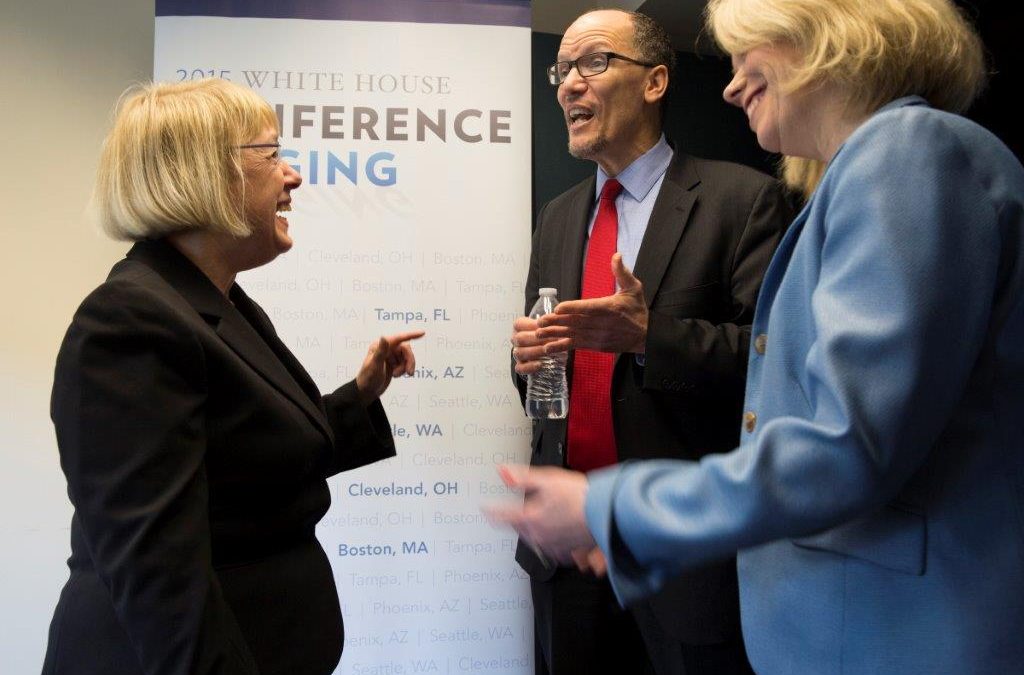
Mar 25, 2016 | aging, aging investor, diminished cognition, elder investor, elderly, finances for elders, financial capacity, finra, senior citizen investor, senior investor, seniors finances
U.S. Senator Patty Murray, U.S. Secretary of Labor Thomas Perez, and WHCOA Executive Director Nora Super discuss aging issues at WHCOA Seattle Regional Forum – Credit: white houseconferenceonaging. gov
What Is This Conference and Why Is It Important?
Every ten years the Federal government sponsors a Conference on Aging.
The relevance of this conference to financial professionals is that it identifies the most common problems aging Americans face and it provides direction for planning for seniors’ needs. It is worth reading the final report. You likely have some boomer age clients and perhaps some aging clients as well. Be aware of what is important to them and you’re likely to keep them as clients.
Who Attended the Conference?
Beginning in February 2015, WHCOA held a series
of regional forums for its Conference on Aging to engage with older Americans, their families, caregivers, leaders in the aging field, and others on the key
issues affecting older Americans.
The concept was to hear about seniors’ issues and plan accordingly. The series of discussions was co-sponsored by AARP and planned
in coordination with the Leadership Council of Aging Organizations, a coalition of more than 70 groups,
Each forum included 200 invited guests — older Americans, family and professional caregivers, aging experts and others. These discussions took place across the country.
Reading about the subjects they discussed and the conclusions reached in the conference Final Report was not a surprise to us at AgingInvestor.com, as we are in the field. But one thing did surprise me completely: no one gave much mention to the need for thorough financial education and planning
with professional help.
There was mention of the Department of Labor’s initiative to facilitate State creation of retirement savings programs. There was also discussion of the U.S. Department of the Treasury’s recently issued guidance clarifying that employers sponsoring defined benefit pension plans generally may not offer lump
sum payments to retirees to replace their regular monthly pensions. As noted in a recent Government Accountability Office report, such lump sum payments transfer longevity risk and investment risk from employers to individual retirees, putting retirees at risk of being unable to maintain their standard
of living or outliving their assets in retirement. Wouldn’t financial advice help? No mention was made of the value of at least seeking advice from financial professionals to maintain income while investing responsibly for those who did get a lump sum payment.
The report emphasizes the need for providing lifetime income and seems to favor employers offering annuities as part of retirement planning. The Treasury and Labor Departments previously have issued
a series of guidance documents encouraging plan sponsors to offer responsible annuity options to help protect retirees from outliving their savings.
The Gap
That may work for some, but I found myself at a loss as to why mention was not made of the importance of professional guidance in financial planning, which may be the best way to ensure that an individual
does not, in fact outlive his savings. That’s your job.
Opportunity for Financial Advisors
An obvious opportunity for financial advisors is to offer financial education to members of the public. Some attendees will not have enough to make new investments, but others will. With 10,000 people turning 65 every day and the oldest boomers turning 70 now, financial advisors can play a key role in helping aging members of society do better with managing their money as they age. Advisors can improve the sometimes negative public perception of the industry by stepping up, putting on few seminars with the basics of saving and investing and capturing some new clients in the process.
Need to update your information about long term care? Get a short book that tells you how to best work with your aging clients, including planning for the costs they may worry about the most. Working With Aging Clients is a sure bet, available at AgingInvestor.com.