

Does Your Aging Client Have Diminished Capacity?

Does Your Aging Client Have Diminished Capacity?

Have you ever wondered about one of your own client’s capacity for making financial decisions?  Professionals who directly or indirectly sell services and products to aging people may not be clear about financial capacity. It is indeed a complex thing, and one should not underestimate how difficult it can be to make a determination about whether a client is impaired. Does the client seem “out of it” sometimes? Forgetful?  Is he acting strangely? Maybe you just dismissed it if you noticed those things. You may have thought, “he’s just getting old”. Maybe you didn’t think it was any big deal. But was it? Diminished capacity may not be obvious at all. Small warning signs can be missed.  And every warning sign is a clue. The clues can mount up and paint a picture.  You need to be able to see it.  And first you need to know what to look for in your aging clients. How do you decide whether someone has diminished capacity for financial decisions? Ultimately, the question of capacity is a legal decision, aided by lawyers, medical professionals and sometimes by judges.  And lawyers also have a difficult time seeing the grey areas and the nuances of thinking that comprise financial decision-making abilities.  One thing every professional working with seniors should know are the warning signs of dementia. If you see enough of these warning signs, your client is likely to be impaired in her financial judgment Excellent information for the public is available on the Alzheimer’s Association website at alz.org. Memory loss is often the first sign of dementia.  There is a difference between memory loss a non-demented person experiences and the memory loss that evolves in to dementia. As an example, forgetting a person’s name is common and we usually remember the name later.  (Does this ever happen to you, “it’s on the tip of my tongue, but I can’t remember right now”?)  People who are developing dementia don’t remember these things later. Their short term memory is eroding steadily.  They forget what was said in the middle of a sentence. They forget appointments. They don’t remember that you spoke with them yesterday. Confusion is another sign.  They may forget where they are going or get lost. They may exhibit unusual behavior from what is normal for them. These are the kinds of things that tip you off that a cognitive problem is looming.  A person who shows you these signs may be impaired for making safe financial decisions. Beware of drawing general conclusions about dementia or Alzheimer's Disease from a single case with which you may have personal experience. If your client is not doing what your grandmother with Alzheimer's did, you can't be certain that your client does not have dementia. Have you as a financial professional had any personal experience with dementia in a family member or client? Let us know about what you did to handle the issues affecting so many. We welcome your input. Need a quick checklist to use to identify the 10 red flags of diminished capacity in your clients? Get yours now by clicking below. It's free. Click here to get your free downloadable Checklist "The 10 Red Flags of Diminished Capacity" Dr. Mikol Davis & Carolyn Rosenblatt, R.N., Elder Law Attorney

What You Can Do About Financial Elder Abuse – CFP Approved Course

What You Can Do About Financial Elder Abuse – CFP Approved Course

“What You Can Do About Financial Elder Abuse”

Register NowMore Information
Summary of course:

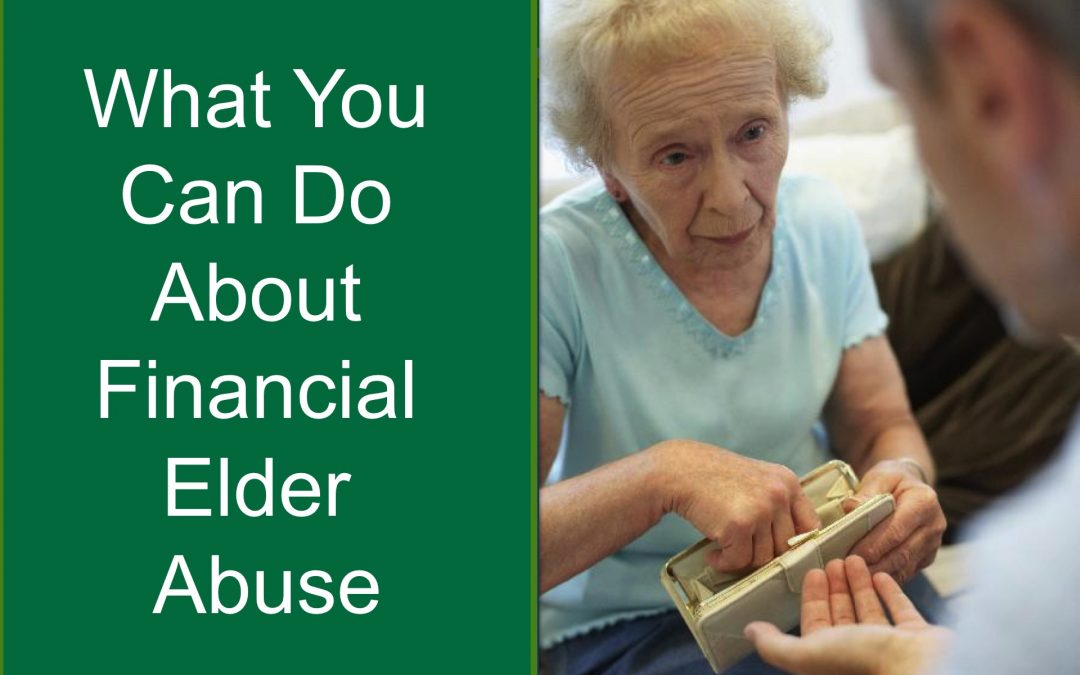
Financial abuse of elders has been called the crime of the century. A recent study shows that it costs seniors over $36B per year in the US. Every hand is needed to prevent and stop this crime of opportunity, including the help of financial professionals. We review the nine domains of financial capacity and describe the seven warning signs that your client may be a victim of financial abuse. We suggest ways that a senior-specific policy can offer advisors a clear path to follow when client conduct puts you on notice of a diminished capacity problem. We show you “hero stories” of financial professionals who took action and did stop abuse.

Learning objectives:
  1. To improve your understanding of the enormity of the problem of financial elder abuse in the US.
  2. To help you understand the legal options that exist to address elder abuse, both in criminal and civil venues.
  3. To improve your understanding of how diminished capacity for financial decisions leads to vulnerability to abuse by predators.
  4. To provide a clear understanding of the seven warning signs of financial abuse.
  5. To provide you with an action plan that so you can take protective action for your clients who appear to be at risk.

Best Practices For Success With Family Meetings – CFP Approved Course

Best Practices For Success With Family Meetings – CFP Approved Course

“Best Practices For Success With Family Meetings”

Register NowMore Information
The family meeting is the bedrock of a successful intergenerational wealth transfer.  But how does the financial professional conduct these? What are the right ways and wrong ways to go about it?
If you want to learn a process, the kind of team you need and the best ways to have family meetings with your client and his heirs, you need this course. We will give you specific pointers on how to get started, how to deal with problematic family issues and how to bring in the best experts to help you. We cover a lot in an hour, so be ready to learn. You’ll come away a lot wiser about establishing a great relationship with your client and those who will inherit his assets.
Summary of course:

Family meetings are the bedrock of successful intergenerational wealth transfers.  In this course you will learn how to help your client develop a family mission statement, and how to create an atmosphere of learning for any willing heirs who will take over responsibility for a family’s assets.  There may be many different kinds of assets a high net worth family has.  Heirs can’t keep control over those different assets without excellent preparation.  We show you how to get that preparation in place and how to make sure it works.  We also teach you about the warning signs of a family that is too dysfunctional for you to be able to help with wealth transfer.  Your understanding and confidence in handling a family meeting will grow by leaps and bounds with this course.

Learning objectives:
  1. To improve your understanding of how wealth transfers fail and how to change this
  2. To enhance your ability to facilitate communication about transfer of wealth in families
  3. To improve your ability to retain management of assets held by aging investors that they intend to pass to their heirs
  4. To increase communication skills for developing trust between yourself, your client and her heirs

Improving Intergenerational Wealth Transfers – CFP Approved Course

Improving Intergenerational Wealth Transfers – CFP Approved Course

“Improving Intergenerational Wealth Transfers”

Register NowMore Information
Summary of course:

It’s pretty well known that intergenerational wealth transfers fail about 70% of the time. What makes the other 30% successful?  If you’d like to learn how you can help your client be part of one of the successful families, you’ll need to understand the critical parts of success and how to achieve them.  Communication is one of the things we talk about in this course. Who better to advise us than an experienced psychologist who has worked with families for over 40 years?  Dr. Davis has given us great information to help ease your way and give you confidence in creating a path to a wealth transfer that works well.

Learning objectives:
  1. Facilitate advisor-led intergenerational communication.
  2. Improve retention of managed assets by establishing relationships with client’s heirs.
  3. Increase communication skills to build new client base of aging client’s heirs.
  4. Implement specific, established and successful communication techniques.