One broker had an $8M client take his assets elsewhere because of a fatal communication mistake. Could it happen to you?
An adult daughter of a broker’s client approached the broker about her father’s recent diagnosis of Alzheimer’s Disease. She asked for his help. He shrugged his shoulders and said, “Basically, I don’t do any of that. I just manage the money”. The daughter was upset, as her father was losing his memory and put his finances at risk. The broker did not wish to get involved with that problem.
Of course, that was the end of his managing the $8M worth of assets.
This situation, having to face a client who has been diagnosed with a brain disease or some other form of cognitive impairment is not unusual and it is becoming a much more frequent issue as our population ages. People are living longer than ever and the risk of Alzheimer’s and other age-related problems rises steadily with age. Can financial professionals just hope this issue will go away because you “only manage the money”? We think not.
The communication, the knowledge and the skill set needed to best manage your aging investors are needed, yet few are seeking to personally improve by acquiring them. How many frustrated family members of your aging clients are going to take assets away from your management because you don’t know what to do and aren’t willing to get out of your comfort zone and be a part of protecting a vulnerable elderly client?
Here are three steps you the professional in a similar situation could take to hold onto the assets, protect the client and let the family know that you care about more than just the assets.
Meet with the family and explore the extent of the impairment. If the client is still competent to sign a privacy waiver, get that done so you can communicate with the client’s appointed representative.
Educate the client’s appointee in your client’s presence about his plans for his investments and the philosophy he has demonstrated in the past. This will ensure continuation of what the impaired person wants going forward.
Set up regular family meetings going forward from the first notice of the problem. This will ease the transition of the client with Alzheimer’s disease out of the seat of power while still respecting the ability he has remaining to communicate about what he wants. It is important to empower the successor to decision making with knowledge the elder may provide while assuring the aging client that his wishes will be honored in the future.
If you are uncomfortable with the whole area of diminished capacity, you can get the skill set you need without taking too much time. Wouldn’t it be great to have more confidence about it?
Get your Fact Sheet for Financial Advisors and learn the red flags of diminished capacity and what to do about them by clicking below.
Have you ever wondered about one of your own client’s capacity for making financial decisions? Professionals who directly or indirectly sell services and products to aging people may not be clear about financial capacity. It is indeed a complex thing, and one should not underestimate how difficult it can be to make a determination about whether a client is impaired. Does the client seem “out of it” sometimes? Forgetful? Is he acting strangely? Maybe you just dismissed it if you noticed those things. You may have thought, “he’s just getting old”. Maybe you didn’t think it was any big deal. But was it? Diminished capacity may not be obvious at all. Small warning signs can be missed. And every warning sign is a clue. The clues can mount up and paint a picture. You need to be able to see it. And first you need to know what to look for in your aging clients. How do you decide whether someone has diminished capacity for financial decisions? Ultimately, the question of capacity is a legal decision, aided by lawyers, medical professionals and sometimes by judges. And lawyers also have a difficult time seeing the grey areas and the nuances of thinking that comprise financial decision-making abilities. One thing every professional working with seniors should know are the warning signs of dementia. If you see enough of these warning signs, your client is likely to be impaired in her financial judgment Excellent information for the public is available on the Alzheimer’s Association website at alz.org.Memory loss is often the first sign of dementia. There is a difference between memory loss a non-demented person experiences and the memory loss that evolves in to dementia. As an example, forgetting a person’s name is common and we usually remember the name later. (Does this ever happen to you, “it’s on the tip of my tongue, but I can’t remember right now”?) People who are developing dementia don’t remember these things later. Their short term memory is eroding steadily. They forget what was said in the middle of a sentence. They forget appointments. They don’t remember that you spoke with them yesterday. Confusion is another sign. They may forget where they are going or get lost. They may exhibit unusual behavior from what is normal for them. These are the kinds of things that tip you off that a cognitive problem is looming. A person who shows you these signs may be impaired for making safe financial decisions. Beware of drawing general conclusions about dementia or Alzheimer's Disease from a single case with which you may have personal experience. If your client is not doing what your grandmother with Alzheimer's did, you can't be certain that your client does not have dementia. Have you as a financial professional had any personal experience with dementia in a family member or client? Let us know about what you did to handle the issues affecting so many. We welcome your input. Need a quick checklist to use to identify the 10 red flags of diminished capacity in your clients? Get yours now by clicking below. It's free.Click here to get your free downloadable Checklist "The 10 Red Flags of Diminished Capacity" Dr. Mikol Davis & Carolyn Rosenblatt, R.N., Elder Law Attorney
There is something about memory loss that should raise a red flag when it comes to your aging clients and their investments. Are you prepared?
By 2030, there will be 72.1 million people in the U.S. over age 65, or “elders”. 7.7 million of them will have Alzheimer’s Disease (AD). This directly translates to a large number of impaired clients making or attempting to make financial transactions and decisions. Some of those transactions could be with you.
According to respected researcher, attorney and neuropsychologist at the University of Alabama, Burmingham, Dr. Daniel Marson, losing capacity for financial decisions is something we need to be ready for, as it affects a huge part of our population. The problem is growing. Financial institutions, organizations and banks need to take preventive steps to avoid financial losses and exploitation of their clients.
What are the implications for the financial services industry? Demographics and dementia demonstrate that policies need to change and institutions need to explicitly plan for diminished financial capacity in their investors. We’re not just talking about escalating a matter to compliance when a client seems to be behaving oddly. We are suggesting that institutions and organizations get over the brick wall excuse that it’s not their problem, it’s the family’s problem. Financial professionals need to change the thinking that privacy concerns prevent them at all times from doing anything unless the client gives permission. A client who is impaired for decision-making may not be willing or able to give permission for you to discuss a problem with family until it is too late. Getting permission needs to be a proactive mandate.
Privacy does not have to be a problem if your organization, institution, or you, as an individual plan for the possibility of diminished capacity as a part of all investment transactions. That planning will include obtaining a special authorization for the financial services professional to contact a designated person when certain criteria are met. That, of course, means thinking through, with the input of aging experts, the criteria that would trigger the use of the special authorization.
Further, one should develop an agreed upon plan of action for the financial professional when the criteria that demonstrate diminished capacity are identified. This will take collaboration among all the players in institutions, so that policy development is uniform, regulation-compliant, and fair to the aging person who may be developing impairment.
Most importantly, a secure path of communication and action for the institution needs to be in place. No one with a questionable aging client should be left wondering:
Should I escalate this to compliance now, or does it take more?
Do I have the authority to contact a family member, or does that violate my client’s privacy and the laws about privacy?
What steps should I take now to protect myself?
Clients with memory loss are likely going to become impaired for making financial decisions at some point. Do you want to lose the assets under your management because your aging investor can’t figure out what you are saying and can’t approve what you need to do to protect him from disaster? We see an absolute connection, based on very solid research, between the dangerous red flag of memory loss and financial loss.
If you have heard the term “sliver tsunami” you may know that it refers to the massive wave of aging folks in our population. In case you haven’t noticed, it has already hit and your feet are getting wet.
Get a one page checklist you can use to identify ten signs of diminished capacity by clicking HERE. Be ready for aging clients and know what to do!
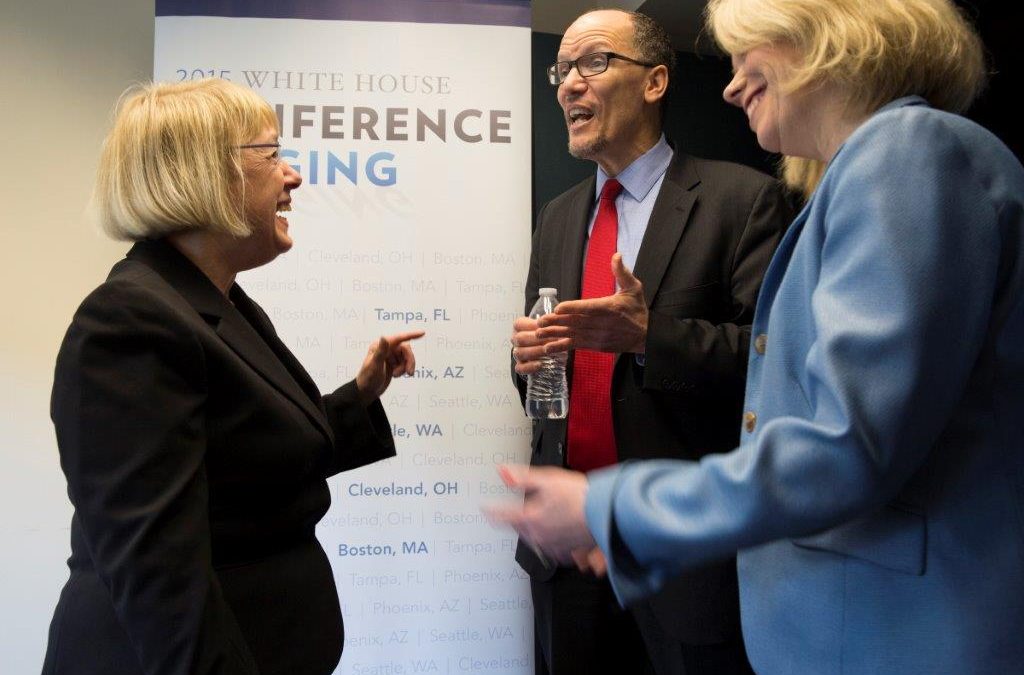
U.S. Senator Patty Murray, U.S. Secretary of Labor Thomas Perez, and WHCOA Executive Director Nora Super discuss aging issues at WHCOA Seattle Regional Forum – Credit: white houseconferenceonaging. gov
What Is This Conference and Why Is It Important?
Every ten years the Federal government sponsors a Conference on Aging.
The relevance of this conference to financial professionals is that it identifies the most common problems aging Americans face and it provides direction for planning for seniors’ needs. It is worth reading the final report. You likely have some boomer age clients and perhaps some aging clients as well. Be aware of what is important to them and you’re likely to keep them as clients.
Who Attended the Conference?
Beginning in February 2015, WHCOA held a series of regional forums for its Conference on Aging to engage with older Americans, their families, caregivers, leaders in the aging field, and others on the key
issues affecting older Americans. The concept was to hear about seniors’ issues and plan accordingly. The series of discussions was co-sponsored by AARP and planned in coordination with the Leadership Council of Aging Organizations, a coalition of more than 70 groups,
Each forum included 200 invited guests — older Americans, family and professional caregivers, aging experts and others. These discussions took place across the country.
Reading about the subjects they discussed and the conclusions reached in the conference Final Report was not a surprise to us at AgingInvestor.com, as we are in the field. But one thing did surprise me completely: no one gave much mention to the need for thorough financial education and planning
with professional help.
There was mention of the Department of Labor’s initiative to facilitate State creation of retirement savings programs. There was also discussion of the U.S. Department of the Treasury’s recently issued guidance clarifying that employers sponsoring defined benefit pension plans generally may not offer lump
sum payments to retirees to replace their regular monthly pensions. As noted in a recent Government Accountability Office report, such lump sum payments transfer longevity risk and investment risk from employers to individual retirees, putting retirees at risk of being unable to maintain their standard
of living or outliving their assets in retirement. Wouldn’t financial advice help? No mention was made of the value of at least seeking advice from financial professionals to maintain income while investing responsibly for those who did get a lump sum payment.
The report emphasizes the need for providing lifetime income and seems to favor employers offering annuities as part of retirement planning. The Treasury and Labor Departments previously have issued
a series of guidance documents encouraging plan sponsors to offer responsible annuity options to help protect retirees from outliving their savings.
The Gap
That may work for some, but I found myself at a loss as to why mention was not made of the importance of professional guidance in financial planning, which may be the best way to ensure that an individual
does not, in fact outlive his savings. That’s your job.
Opportunity for Financial Advisors
An obvious opportunity for financial advisors is to offer financial education to members of the public. Some attendees will not have enough to make new investments, but others will. With 10,000 people turning 65 every day and the oldest boomers turning 70 now, financial advisors can play a key role in helping aging members of society do better with managing their money as they age. Advisors can improve the sometimes negative public perception of the industry by stepping up, putting on few seminars with the basics of saving and investing and capturing some new clients in the process.
Need to update your information about long term care? Get a short book that tells you how to best work with your aging clients, including planning for the costs they may worry about the most. Working With Aging Clients is a sure bet, available at AgingInvestor.com.