
Jun 18, 2016 | aging, elderly, financial elder abuse, scammers, senior investor
A judge agreed with Fireman’s Fund insurance company’s retirees who sued the employer for introducing them to “financial education seminars”. They attended, followed the advice given and lost everything. Maybe you thought this only happened to naive older folks preyed on by slick salesmen outside the workplace. But no. It happened to 34 long time employees and retirees of Fireman’s Fund who lost most or all of their retirement savings by being misled into risky investments.
(more…)

Jun 15, 2016 | aging, aging investor, diminished cognition, elder investor, finances for elders, financial capacity, financial elder abuse, finra, handling money for aging parents, handling money for seniors, scammers, senior citizen investor, senior investor, seniors finances
Is financial abuse happening to YOUR clients right now? Of course it is. There is no escaping it. A recent study puts the amount stolen from elders every year in our country at over $36B. With a problem as big as this, no group of elders is immune.. If you took a survey of your existing clients all age 65 or older, and asked them how many have ever been taken advantage of financially, you would be sure to get some clients who would admit to this. If you look at your own experience and count up any instance you know of, whether it is in your family, your neighborhood or your book of business, you will likely find some financial abuse as well.
Why Is This Important for You?
The amounts stolen, fraudulently taken or just snatched from the unwary, are shocking. Remember that when your client loses assets, you lose fees. That is the most basic reason this should be important to you as a financial professional. Doing the right thing to keep your clients safe is certainly a motivator as well. It shows that you do care about them. And beyond that, the regulators are increasingly aware that financial professionals are in a position to take action and, sometimes, to stop and prevent financial abuse. They will soon get past merely urging you to take action and to report abuse. They will ultimately make it mandatory.
And we think you can do more proactively than merely to understand how to report abuse after the fact. It would be great to catch more criminals but that is extremely difficult in many cases because they are very clever at evading law enforcement. And since family members are the most frequent abusers, we have an added problem in that many elders are reluctant to report abuse by their own to law enforcement. Mom just won’t call Adult Protective Services on her son, even when she knows he has stolen from her. We have seen this with our own eyes There are many instances of scammers getting into relationships with aging folks by phone or on the internet. The “friendly” relationships become addictive. These thieves persuade the victim to withdraw funds from their accounts. This is where the advisor comes in. Unusual withdrawals are an important warning sign of elder abuse. And when the advisor notices this in a client’s account there are choices available about stopping abuse. They include contacting a trusted other the elder has identified and warning them of what is happening. There should be more than one trusted person identified for every client. And by all means, contact Adult Protective Services and report it if you suspect fraud.
If you are worried about privacy rules, don’t be. The regulators of your industry want you to report abuse. They want you to make every effort to keep aging clients financially safer. If you are not sure about privacy, we can help you create a special privacy document here at AgingInvestor.com that gives you permission to call that third party. Every advisor with any client over age 65 should have this and understand how to approach a client about signing it. With permission like this, you should never hesitate to tell APS and the trusted other that you are concerned about your client being financially manipulated.
You can get more details about this elder abuse issue and what you can do as an advisor in Succeed With Senior Clients: A Financial Advisor’s Guide to Best Practices. See particularly the chapter “Financial Elder Abuse: How You Can Fight the Crime of the Century“. It’s available right now so click HERE to get your copy today.
by Carolyn Rosenblatt, RN, Elder law attorney, AgingInvestor.com

Mar 25, 2016 | aging, aging investor, elder investor, elderly, finances for elders, financial capacity, handling money for aging parents, scammers, senior citizen investor, senior investor, seniors finances
Do you have any clients over age 65? They may not know about: the grandma scam. Although the government, local agencies and sometimes the media publicize these predatory traps for elders, somehow the word doesn’t get around fast or far enough. Here at AgingInvestor.com, we work with a lot of families who have elders and we’ve been sounding the alarm since 2007 on this one. But it persists. Intelligent people, doctors, lawyers, professionals and non professionals alike are being victimized. Anyone can be caught off guard.
Here’s how the grandma scam works –
A call from a young person is made to the targeted older person, often at night, after the aging person is asleep. Half awake, grandma answers the phone. ”It’s me, Grandma” the caller says. Grandma immediately falls into the trap and says “Michael, is that you?” Or any grandchild who is named instantly becomes the identity of the caller. ”Yes, it’s Michael” the scammer says quickly. He then says he’s in trouble in some named city far away or even a foreign country. He’s lost his passport, or been arrested, he’s in the hospital, he’s very sick, or some concocted tale of needing help desperately. There is pain in his voice. He says how much he loves his Grandma and please don’t tell his parents. He needs money right away for the bill or for a laywer to get him out of jail or to get a new passport, etc. Would Grandma please wire the money? The targeted victim has to act right away. But repeatedly, older gullible people are swayed by the feeling of wanting to help a grandchild in need. And they don’t take time to think.
Grandma is so concerned, she gets that cash wired to the scammer right away. She doesn’t check anything out and she doesn’t call her son or daughter, the parents of the fake grandchild. It takes a while before she realizes she’s been had. Millions of dollars are lost this way, in smaller amounts at a time. No matter how much the press reports this kind of scam, the thieves keep at it, as they know that about one in fifty calls will result in getting money from an unsuspecting person.
Why are these con artists getting away with it? Dialing for dollars all day is quicker and easier than robbing a bank and it gets better results. The con artists rarely get caught. The money, once wired, is gone forever from the victim. And due to shame and embarrassment, victims rarely report the scam artists to the police. Con men buy names from subscription lists with likely senior citizen readers or from other information brokers. Some have the ages of their targets and their addresses. Sometimes the more sophisticated ones have even researched the names of family members, so calling Grandma is more likely to sound credible. If the caller’s voice isn’t recognizable, there is always an excuse: I have a cold, I’m really sick, or anything that works to persuade Grandma it’s really her grandson.
What’s the takeaway?
Your client can be easily tricked under the right circumstances. Wanting a call from grandkids is the starting point for scammers. It triggers an emotional response to the plea for help. “I love you” is something the grandparent wants to hear and the emotional hook is the basis of the con man’s success. Warn every aging client to be aware of the scam and to ask the caller a question only a real grandchild would know: the name of a pet, a parent’s birth date or a nickname.
Financial professionals are in a unique position to educate clients about finances and how to keep from losing money. Thwarting abuse is so important! Have you ever had a client get scammed? Have you seen ripoffs from their own family members? We’d like to hear your perspective on this. Comments welcome.
Learn what you can do about elder abuse at AgingInvestor.com in a one hour accredited course. Check it out here.
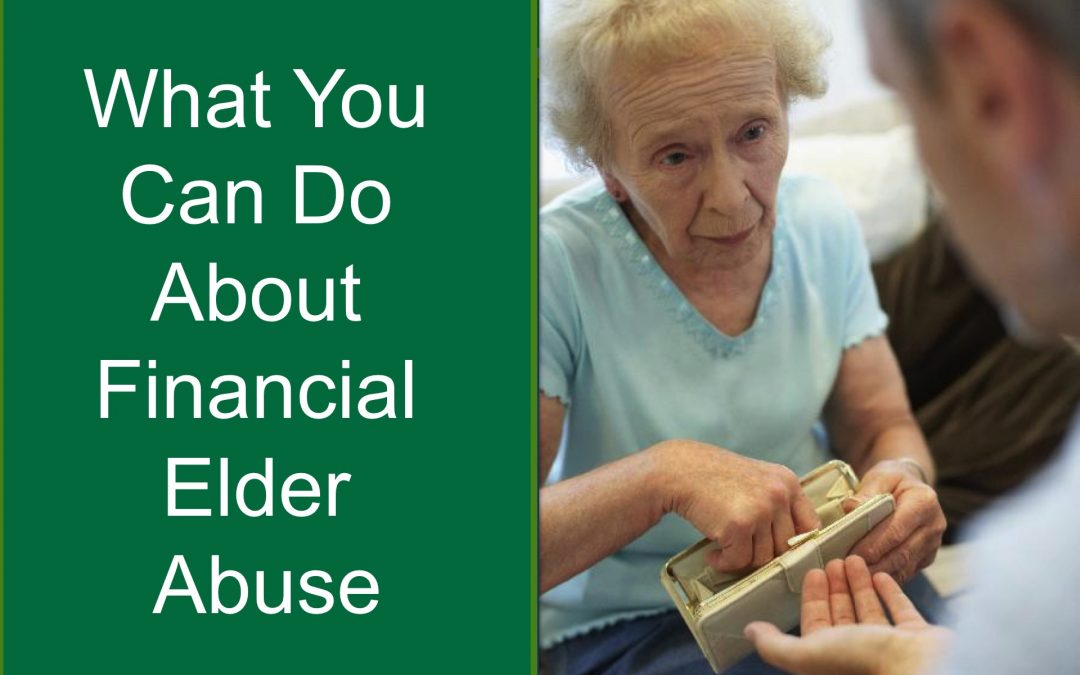
Jan 16, 2016 | aging, aging investor, elderly, financial elder abuse, investor, scammers, senior citizen investor, senior investor
“What You Can Do About Financial Elder Abuse”
Summary of course:
Financial abuse of elders has been called the crime of the century. A recent study shows that it costs seniors over $36B per year in the US. Every hand is needed to prevent and stop this crime of opportunity, including the help of financial professionals. We review the nine domains of financial capacity and describe the seven warning signs that your client may be a victim of financial abuse. We suggest ways that a senior-specific policy can offer advisors a clear path to follow when client conduct puts you on notice of a diminished capacity problem. We show you “hero stories” of financial professionals who took action and did stop abuse.
Learning objectives:
- To improve your understanding of the enormity of the problem of financial elder abuse in the US.
- To help you understand the legal options that exist to address elder abuse, both in criminal and civil venues.
- To improve your understanding of how diminished capacity for financial decisions leads to vulnerability to abuse by predators.
- To provide a clear understanding of the seven warning signs of financial abuse.
- To provide you with an action plan that so you can take protective action for your clients who appear to be at risk.


Aug 29, 2015 | aging, elderly, financial elder abuse, scammers, senior investor
When the medical information and personal data of 80 million Americans was hacked at Anthem Blue Shield it served as a wakeup call. It provides us with another way concerned professionals can educate and warn their clients about keeping personal data safe.
Get this: The information gained by the hackers – including social security numbers and birth dates and even income – are an identity thief’s dream, and the massive breach makes clear that any record can be at risk when companies fail to take security seriously. (more…)