Why You Shouldn’t Wait For Regulators To Tell You What To Do About Elder Abuse

Why You Shouldn’t Wait For Regulators To Tell You What To Do About Elder Abuse

Investment News posted an article describing how the North American Securities Administrators Association has formed a new Committee on Senior Issues and Diminished Capacity, which will be headed by Montana Deputy Securities Commissioner Lynne Egan and include 13 regulators from across the country.The SEC Investor Advisory Committee has also tasked itself with what it described as an urgent need to protect retirees who are losing mental ability.

State enforcement statistics compiled by NASAA show that 34% of actions since 2008 involve senior victims.

These groups are very committed to finding out what best practices should be.  The NASAA committee could develop a model rule over the next year. With over a dozen people on a committee how many of you think they’ll have rules put together anytime soon?
 
Admittedly, this is an urgent problem.  Over $36B is stolen from elders every year, according to a recent study.  You can and should be developing your own best practices right now.
The longer we wait for government or any regulatory agency to tell us what to do about elder abuse, the longer we delay acting when we see it before our eyes. It doesn’t require a government rule or a professional organization’s sanction to act with common sense on your own.

(more…)

Seniors’ Desperation: A Perfect Tool For Elder Abuse

Seniors’ Desperation: A Perfect Tool For Elder Abuse

Can you think of anything that makes a person more desperate than being in pain?  You can't stand it. Maybe you'll fall for anything that promises to end your pain.

My mother in law, Alice, at 92 was feeling like that. She had chronic knee pain that was getting worse.  She went with some friends to a"free lunch seminars", always a vehicle for selling something.

This one was put on near a large retirement community.  The place is full of fairly well to do elders, some quite wealthy.  Nice target, right?  The perpetrator in this situation was a chiropractor.  He knew exactly what he was doing, promising to end everyone's chronic pain.  All they had to do was sign up for his "guaranteed" to work pain relief program for a mere $3000 payable in advance and of course, nonrefundable.  He carefully never put the guarantee in writing, but he used verbally it to seduce anyone there into believing his promise of pain relief.

Alice signed up.  I advised her not to go through with his program and politely told her there were suspicious things I found in checking him out.  She said she was ready to try anything and he assured her that everyone got good results. She went anyway.

The chiropractor in question didn't even see her. His assistant did the work, which involved very brief "treatment" and a very long pressured talk to try to get her to buy his expensive supplements which they now said would enable the treatment to work.  As the scam became more obvious, Alice got disgusted. The "treatment" did nothing at all for her pain.  She quit and asked for her money back. No dice.

With her permission we filed a complaint with the State Chiropractic Board. which prosecutes fraud and license violations through the state Attorney General. They pursued the chiropractor, eventually settling with him.  He paid a fine and was probably placed on probation. Of course none of this gets Alice her money back.  At last check he's still in business.

Pain relief is a big opportunity for scammers. They may be chiropractors or others who have some kind of license. They may be selling magic potions on the internet.   It could start with one amount and escalate as it did with the chiropractor to expensive add ons, his "supplements".

Recent research shows that many seniors who get taken for relatively small amounts of money often become victims in escalating amounts over time. They want to trust when they feel desperate and that makes them vulnerable to manipulation.

What can you do as a professional if your client is victimized by a scam?  Here are three things:

  1. If you learn about this sort of shady character, encourage your client to fight back. File a complaint. Write a letter to the entity in power. You can offer your help with paperwork or filling out a complaint form. Not every predator can be stopped but some can if you help your client take action.
  2.  Warn other older clients. If you have aging clients, warn them by letter or email about any shady operators in your area.  You never know who you might be saving by doing that.
  3. Make it public. If your client's story is useful and you get permission to share it, local newspapers, TV or radio stations may be interested in it.  That's one way to educate and thwart these predators.

Do you have an experience of seeing a client get taken advantage of by a shady character like the chiropractor here? We'd like to hear from you. Your colleagues can also learn from you. We invite you to send us your stories. Please email me: carolyn@aginginvestor.com.


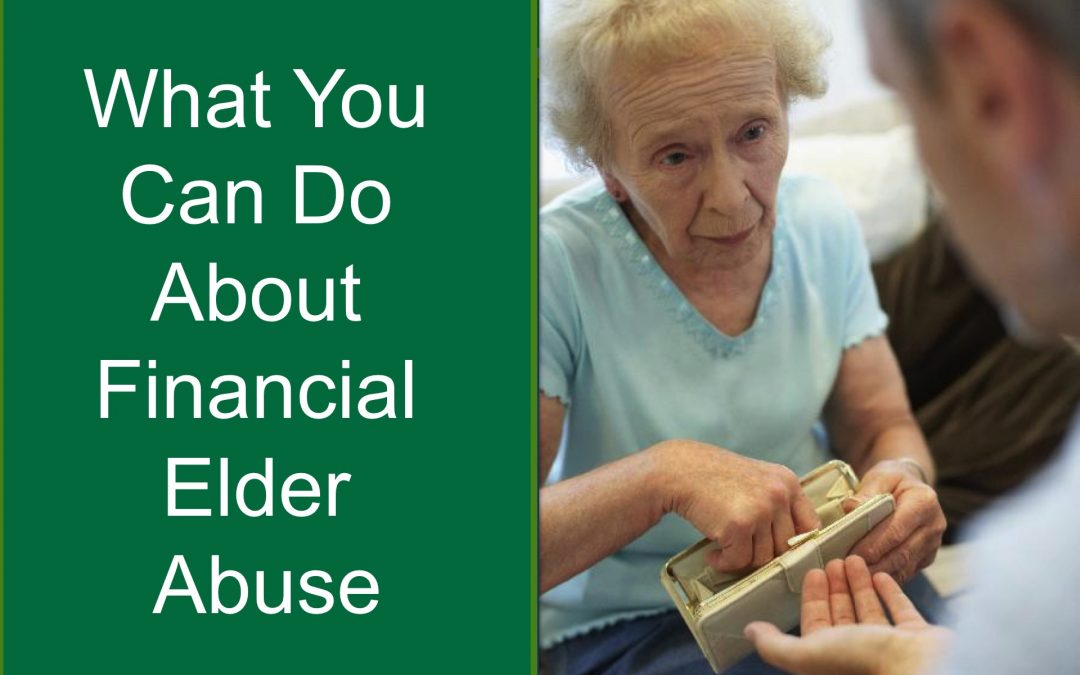
What You Can Do About Financial Elder Abuse – CFP Approved Course

What You Can Do About Financial Elder Abuse – CFP Approved Course

“What You Can Do About Financial Elder Abuse”

Register NowMore Information
Summary of course:

Financial abuse of elders has been called the crime of the century. A recent study shows that it costs seniors over $36B per year in the US. Every hand is needed to prevent and stop this crime of opportunity, including the help of financial professionals. We review the nine domains of financial capacity and describe the seven warning signs that your client may be a victim of financial abuse. We suggest ways that a senior-specific policy can offer advisors a clear path to follow when client conduct puts you on notice of a diminished capacity problem. We show you “hero stories” of financial professionals who took action and did stop abuse.

Learning objectives:
  1. To improve your understanding of the enormity of the problem of financial elder abuse in the US.
  2. To help you understand the legal options that exist to address elder abuse, both in criminal and civil venues.
  3. To improve your understanding of how diminished capacity for financial decisions leads to vulnerability to abuse by predators.
  4. To provide a clear understanding of the seven warning signs of financial abuse.
  5. To provide you with an action plan that so you can take protective action for your clients who appear to be at risk.

Are Seniors At Risk For Data Hacking? You Bet!

Are Seniors At Risk For Data Hacking? You Bet!

When the medical information and personal data of 80 million Americans was hacked at Anthem Blue Shield it served as a wakeup call. It provides us with another way concerned professionals can educate and warn their clients about keeping personal data safe.

Get this: The information gained by the hackers – including social security numbers and birth dates and even income – are an identity thief’s dream, and the massive breach makes clear that any record can be at risk when companies fail to take security seriously. (more…)

The Chronic Pain Relief Scam, Another Ripoff Of  Vulnerable Seniors

The Chronic Pain Relief Scam, Another Ripoff Of Vulnerable Seniors

Mom just turned 93 years old. In fact it was her birthday yesterday. I surprised her with an unscheduled visit. She was so very happy to see me and to not have to spend her birthday alone. Once at her home, I noticed a bill from one of her doctors lying on her table. I inquired about why she was seeing a new chiropractor. She proceeded to show me two small red led light boxes she was using,  prescribed by the new doctor to decrease the pain in her legs. Mom said she had been going to the doctor for over 3 months and she wanted to surprise me with how much better her balance and walking had become. However, sadly, there was no progress. I felt sad for my mother who has been searching for many years for a cure to her chronic leg pain. But the real surprise came when I looked at her bill from the doctor. The doctor had charged her $3800 for the treatment that claimed to improve her balance and decrease her leg pain. He had charged Medicare for the $3800 and the Government had paid him over $700. He then billed her the balance of $3000. This practice is called “BALANCE BILLING” and is against the law. If the doctor accepts Medicare, he must accept that is total except the 20% Medicare does not cover. When her doctor presented her with the outstanding balance, she said she could not pay that amount, so the doctor suggested that she sign up  for “Care Credit” to help her. He told her she could just pay as little as $30 per month and that sounded really good to mom. So mom had been paying 26.99 % APR on the $3000 balance.

Please pay close attention to your aging loved ones especially when it comes to how easily they can get Scammed. This has been another very painful lesson for all of us.