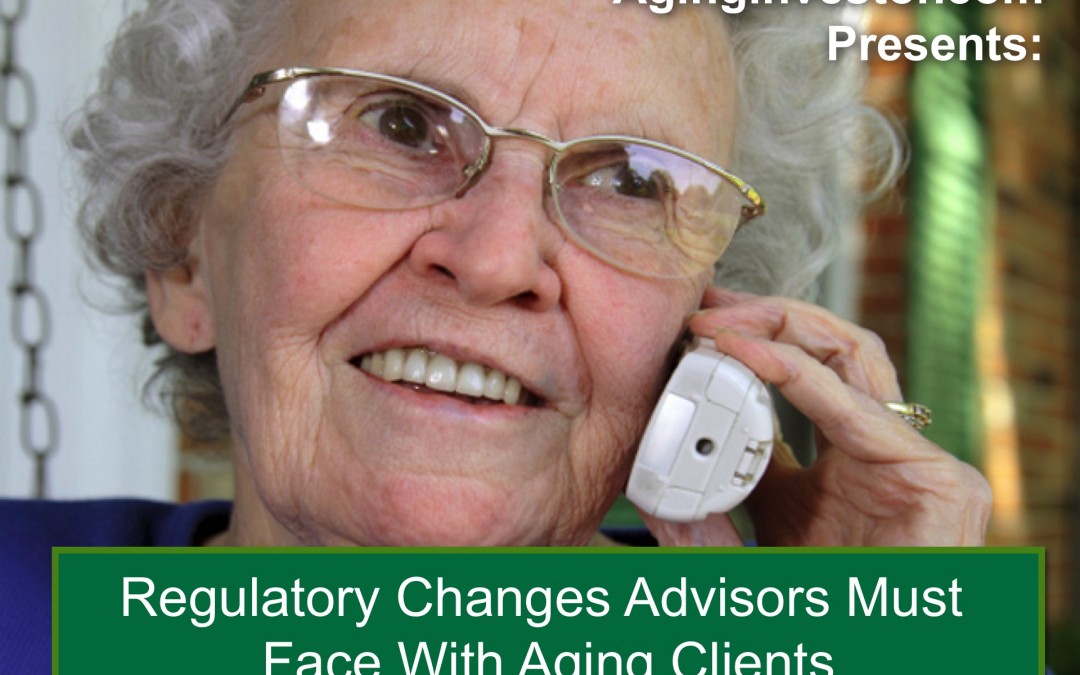
One broker had an $8M client take his assets elsewhere because of a fatal communication mistake. Could it happen to you?
An adult daughter of a broker’s client approached the broker about her father’s recent diagnosis of Alzheimer’s Disease. She asked for his help. He shrugged his shoulders and said, “Basically, I don’t do any of that. I just manage the money”. The daughter was upset, as her father was losing his memory and put his finances at risk. The broker did not wish to get involved with that problem.
Of course, that was the end of his managing the $8M worth of assets.
This situation, having to face a client who has been diagnosed with a brain disease or some other form of cognitive impairment is not unusual and it is becoming a much more frequent issue as our population ages. People are living longer than ever and the risk of Alzheimer’s and other age-related problems rises steadily with age. Can financial professionals just hope this issue will go away because you “only manage the money”? We think not.
The communication, the knowledge and the skill set needed to best manage your aging investors are needed, yet few are seeking to personally improve by acquiring them. How many frustrated family members of your aging clients are going to take assets away from your management because you don’t know what to do and aren’t willing to get out of your comfort zone and be a part of protecting a vulnerable elderly client?
Here are three steps you the professional in a similar situation could take to hold onto the assets, protect the client and let the family know that you care about more than just the assets.
Meet with the family and explore the extent of the impairment. If the client is still competent to sign a privacy waiver, get that done so you can communicate with the client’s appointed representative.
Educate the client’s appointee in your client’s presence about his plans for his investments and the philosophy he has demonstrated in the past. This will ensure continuation of what the impaired person wants going forward.
Set up regular family meetings going forward from the first notice of the problem. This will ease the transition of the client with Alzheimer’s disease out of the seat of power while still respecting the ability he has remaining to communicate about what he wants. It is important to empower the successor to decision making with knowledge the elder may provide while assuring the aging client that his wishes will be honored in the future.
If you are uncomfortable with the whole area of diminished capacity, you can get the skill set you need without taking too much time. Wouldn’t it be great to have more confidence about it?
Get your Fact Sheet for Financial Advisors and learn the red flags of diminished capacity and what to do about them by clicking below.
Have you ever wondered about one of your own client’s capacity for making financial decisions? Professionals who directly or indirectly sell services and products to aging people may not be clear about financial capacity. It is indeed a complex thing, and one should not underestimate how difficult it can be to make a determination about whether a client is impaired. Does the client seem “out of it” sometimes? Forgetful? Is he acting strangely? Maybe you just dismissed it if you noticed those things. You may have thought, “he’s just getting old”. Maybe you didn’t think it was any big deal. But was it? Diminished capacity may not be obvious at all. Small warning signs can be missed. And every warning sign is a clue. The clues can mount up and paint a picture. You need to be able to see it. And first you need to know what to look for in your aging clients. How do you decide whether someone has diminished capacity for financial decisions? Ultimately, the question of capacity is a legal decision, aided by lawyers, medical professionals and sometimes by judges. And lawyers also have a difficult time seeing the grey areas and the nuances of thinking that comprise financial decision-making abilities. One thing every professional working with seniors should know are the warning signs of dementia. If you see enough of these warning signs, your client is likely to be impaired in her financial judgment Excellent information for the public is available on the Alzheimer’s Association website at alz.org.Memory loss is often the first sign of dementia. There is a difference between memory loss a non-demented person experiences and the memory loss that evolves in to dementia. As an example, forgetting a person’s name is common and we usually remember the name later. (Does this ever happen to you, “it’s on the tip of my tongue, but I can’t remember right now”?) People who are developing dementia don’t remember these things later. Their short term memory is eroding steadily. They forget what was said in the middle of a sentence. They forget appointments. They don’t remember that you spoke with them yesterday. Confusion is another sign. They may forget where they are going or get lost. They may exhibit unusual behavior from what is normal for them. These are the kinds of things that tip you off that a cognitive problem is looming. A person who shows you these signs may be impaired for making safe financial decisions. Beware of drawing general conclusions about dementia or Alzheimer's Disease from a single case with which you may have personal experience. If your client is not doing what your grandmother with Alzheimer's did, you can't be certain that your client does not have dementia. Have you as a financial professional had any personal experience with dementia in a family member or client? Let us know about what you did to handle the issues affecting so many. We welcome your input. Need a quick checklist to use to identify the 10 red flags of diminished capacity in your clients? Get yours now by clicking below. It's free.Click here to get your free downloadable Checklist "The 10 Red Flags of Diminished Capacity" Dr. Mikol Davis & Carolyn Rosenblatt, R.N., Elder Law Attorney
Update on what the SEC, FINRA an NASAA have in mind for financial professionals across the country in how they do business with clients over age 65. Review of the research these agencies have done, Model Rules regulators have created and what exemplary things they found firms and organizations doing for aging clients. They all want financial professionals to be more protective of aging investors. They envision mandates for reporting financial abuse of elders will and expand mandates into other areas. This course highlights areas regulators expect advisors to address, such as training in senior issues and increased communication with aging clients. It provides specifics on how to get ready for what the regulators want so that you will not have to scramble to comply with mandates.
Learning Objectives:
Understand the regulators’ concept of a “senior program” and how you can create one.
Know the Model Rules about financial abuse the regulators have already publicly posted.
Know what other firms across the US are doing about aging investors that you should be doing too.
Know what action steps you can and should take now to be ready for mandates.
Our population is living longer than ever. The risk of dementia rises with age. That means that most of us are going to encounter problems of aging in our clients.
We need to recognize the red flags of impairment that will affect financial capacity. These include:
Cognitive signs, such as memory loss and difficulty understanding the conversation
Communication, calculations and orientation problems
Emotional signs that are out of character for your client.
It is essential for every financial professional to understand the complexity of financial capacity and appreciate how many parts it has. There are 9 domains of financial capacity. You cannot determine if a person is impaired or not just by talking on the phone with her or having a brief meeting in which you give information.
A normal social conversation with the client is not a measure of whether or not the client has diminished financial capacity.
The more aware you are as a professional, the better chance you have of protecting your client from loss and protecting yourself as well.
Learning objectives:
Prepare yourself for the wave of aging clients by understanding the demographics of our aging population and the risks of dementia associated with aging.
Understand the 9 domains of financial capacity and learn how to spot problems with any one of them.
Be able to identify red flags of impaired cognition that should prompt you to act.
Develop a personal plan for what to do when you see warning signs of diminishing financial capacity